
Swapping necks on my Corvettes

Joined
Apr 12, 2007
Messages
1,319
Reaction score
17
For months now I’ve toyed with the idea of swapping necks between my fretted $$ and fretless standard Corvettes. I’m very hesitant to give it a try, though - I’ve never removed the neck from any of my basses (or guitars) before, so I don’t know what pitfalls I ought to look out for.

I know there are other threads on this subject, and that it has been done before, but I read a post from Florin recently that mentioned something about the necks being fitted to a particular body….so I’m cautious.

If any of you have advice and/or things to look out for please let me know!

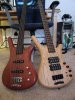
Pics of the basses in question:
 

Attachments

  • Neck Swap 001_sm.jpg
    Neck Swap 001_sm.jpg
    98.5 KB · Views: 400
  • Neck Swap 004_sm.jpg
    Neck Swap 004_sm.jpg
    85.1 KB · Views: 407


It's really easy, but you need a grasp of
the procedure of shimming necks for the
neck-body angle.

You don't actually try to measure or even
see the angle. But you deal with evidence
of any change in angle ... as manifested
by changes in action height. Not relief but
action height, as controlled by the saddle
height adjustment.

Essentially, you put the new combination
together, tune up, set the relief [which is
only gonna change if the neck encounters
a very different type of string than it was
playing before the swap] and then you
HOPE the action height is cool, or can be
adjusted to coolth, without bottoming out
the saddles or setting them silly-ass-high.

If they bottom out, you gotta lower the
headstock instead of excessively lowering
the saddles. Vice versa leads to vice versa,
as you'd expect. To lower the headstock
you shim the back end of the neck pocket
[toward bridge]. Vice versa for vice versa.


~~~~~~~~~~~~~~~~~~~~~~~~~~


I use plastic [consumer 'blister' packaging]
cuz I hope it's more stable over time than
the traditional biz card. But "biz card" is a
sorta semi-official measure of thickness. In
rare cases, '1 BC' is too much shim, and yet
'0 BC' is not a good set up. Usually it's 1 BC,
while 2 BC is already getting extreme.

You gotta realize how very much of elevation
change occurs at the headstock for just 1 BC
of shim in the neck pocket. Consider the trig.
Hate math ? There's no calculations, but you
gotta have a grasp of the magnification you
get. The neck pocket is about 4" long while
the headstock is about 2 ft away from there !

2 ft vs 1/3 ft [aka 4"] is a magnification of
about 6:1. That means a 1 BC shim produces
about 6 BC elevation shift at the headstock,
and an opposite elevation shift at the saddles.
However the shift at the saddles is only about
half as great. For it to be equal on both ends,
the neck pocket would hafta be at the 12th
fret. Never mind the actual math, but do get
a grasp on the idea of this magnification on
the effect of the shim.

~~~~~~~~~~~~~~~~~~~~~~~~~~~~

I also cut shims from disposable aluminum
bake ware [pie pans, etc]. Advantages over
clear plastic:
1. No annoy static clinging and repelling.
2. Not invisible when you forget where you
put it down, or when you drop it.
3. Easy to scribe an outline onto it.

There's some dexterity and creativity needed
to be sure that the shim stays where you want
it to be while you re-assemble everything. My
methods suit me, my lazy nature, and my own
resources at hand. Yours will differ. But do be
sure the shim ends up where it's spozed to be.

My 6:1 magnification figger is loose as a goose.
There's all kinda sooprize variables, but it's an
OK working figger for just setting the scene.


Last edited by a moderator:
One issue would be how much to tighten the bolts after the swap. I suspect Warwick uses a standard torque when fastening bolts, not too little, not too much. But you could probably go with "as much as it goes". Tyler Durden should know since he does that every time he waxes. :)

You may also have to do a little sanding for one of the necks if it is wider, since it's such a tight fit with the neck pocket. For the same reason, take care not to snap any small pieces of wood from around the neck pocket while installing. Other than that, since they are the same type of 'wick, I wouldn't expect too many surprises. Use the right tools and take your time.
 
If you decide to go about that, pre/post sound clips would be really interesting.
 
golem - I should have anticipated that you'd address the shim thing (esp. for the non-dial-a-mwah basses...ha ha) thanks for reminding me about it. I will probably have more specific stuff to ask once I git into it. I'll stock up on disposable aluminum bake pans in the mean time;)
 
I found that when i re-bolted the neck on my old rockbass that i couldn't get the bolts tight enough to keep the neck from bending upwards from string tension (obviously after i had restrung)

Andbody know why that might have been, was i doing something really dumb or am i just pathetic and puny?
 
One issue would be how much to tighten the bolts after the swap. I suspect Warwick uses a standard torque when fastening bolts, not too little, not too much. But you could probably go with "as much as it goes". Tyler Durden should know since he does that every time he waxes. :)

You may also have to do a little sanding for one of the necks if it is wider, since it's such a tight fit with the neck pocket. For the same reason, take care not to snap any small pieces of wood from around the neck pocket while installing. Other than that, since they are the same type of 'wick, I wouldn't expect too many surprises. Use the right tools and take your time.

bolt / hole alignment and torque has actually been what I've worried about most. I must say though, that sanding the pocket to squeeze another neck in worries me even more...sheesh!
 
I found that when i re-bolted the neck on my old rockbass that i couldn't get the bolts tight enough to keep the neck from bending upwards from string tension (obviously after i had restrung)

Andbody know why that might have been, was i doing something really dumb or am i just pathetic and puny?

the thought of this happening is exactly what has stopped me from just diving into it...yikes! I would be sooooo beside myself if ended up with two unplayable basses...

Pedro - did you swap the neck from another bass or simply remove an existing one and put it back on?


The Dial-A-Mwah basses are those where
I've done the most swaps. These actually
come from SLO with shims color-coded by
thickness already installed. I have never
known whether the shim "belongs" to the
neck or the body.

I assume that a neck is a more precisely
made product than a body, which is to say
that I figger the shim belongs to the body
cuz the shim adjusts for a variable and it's
prolly the body that IS the variable.

Whatever, the reason I never find out is
cuz it's all meaningless. I can keep each
shim with it's assigned body thru a swap
and I still hafta reshim everything. I've
even done a 3-way swap in D-A-M land,
and I now have an accumulation of those
factory shims in my parts collection.

Dial-A-Mwah is about relief. Shimming is
not. It's about saddle height adjustment,
about keeping it in a reasonable range.


Pedro, it sounds like you maybe stripped the
existing threads in one or more holes. Also,
you gotta screw the whole set down gradually,
moving from screw to screw, but keeping a
bit more emphasis toward the front [head] in
the process.

If the holes are stripped, you can use the old
white glue and toothpicks trick. It's not just
for strap buttons ! You don't need to be any
sorta master woodshop worker to do a more
than good enuf job for neck screws, even with
the heavey load they get.

Only other thing I can think of is all that crap,
primer dust compressed into chunks, that can
break loose and make trouble. Once you pull a
neck, you gotta clean up good afore you can
put it all back together.


~~~~~~~~~~~~~~~~~~~~~~~~~~~~


Thing about neck swaps is that they're easy,
no special skills or tools, but they're tedious.

I've never had an alignment problem related
to the hole patterns. Location of the holes, in
my experience, is about the most consistently
reliable thing in the whole kitandkaboodle.

BTW even with a make or model of bass where
all the neck pockets are spozedly all the same
since God was in diapers, there will be fewer
sooprizes with basses of similar age, and even
better with less age. Swapping between recent
and vintage can turn out with a hint of extra
clearance in one new assemblage and a lack of
clearance in the other. Usually, mild sanding is
in order. It's not scary. You work carefully and
anywayz the alignment is in the screw holes.


Last edited by a moderator:
I found at least on bo thumbs the bolt holes are spaced different depending on the year of the bass.I have swapped necks between two of my vetts with no problems.I wouldn't sand down the neck to fit unless your happy with the way both necks fit in there new homes.I have seen sandpaper used as neck shims.I like to use brass shim stock for the neck shim if it needs one or a thin pc of maple.What I like about the warwick bridge is you can machine down the base to let the upper pc sit lower.I did this to two bass cause I don't like to shim a neck I don't have to.
 
I had 2 Corvette Std 5ers, both fretted, that I swapped the necks between, simply because i wanted both better bits of wood on the one bass :)

Went fine, no dramas at all.
 
......I have seen sandpaper used as neck shims.......


Sandpaper is common fix for left-right
alignment stability when the holes are
too big and the pocket is too sloppy. If
the sandpaper is the full length of the
'floor' of the pocket, then it's all about
friction, to hold left-right alignment on
a sloppy fit.

I personally would avoid sandpaper for
real shimming, for tilting. I'd worry the
grit, under pressure, would bite deeper
into the wood and paper over time, so
the effective thickness would change.

With a full length friction fix, a change
in thickness wouldn't matter. It would
be uniform enuf all over, so no change
in neck tilt should occur.

OTOH, I've been known to worry about
schidt thaz never really gonna matter.


The sandpaper I saw was used for shimming the neck.I can't remember the brand of bass though.I don't use it,I think the maker used left over scraps.I can see how pressure over time could change the thicknes of the sandpaper.But I don't think it would shrink that much.
 
Just make sure that when you take off your neck, that you remember where the bolts went, and make sure to not cross thread them.

At least on my Streamer the backward two bolts (Closest to the bridge) are a bit longer than the ones nearest the headstock.


And write the date, and your initials, on
the body and neck hidden in the pocket.


something you need to do to mark your teritory. I use the electronics compartment.
 
something you need to do to mark your teritory. I use the electronics compartment.

I suppose my initials / date is a better idea than pissing on it, eh?:d

Anywayz...I'm gonna make the swap sometime in the next couple days. the only point of hesitation I have now is that the neck of the fretless does go so well with the body wood of the fretless (see pics above)...ahh well...

oh, and I will document this thoroughly with before and after sound clips and pics. maybe even some video
 
Back
Top