
Stage II and Thumb NT Bodies

Joined
Sep 12, 2009
Messages
215
Reaction score
12
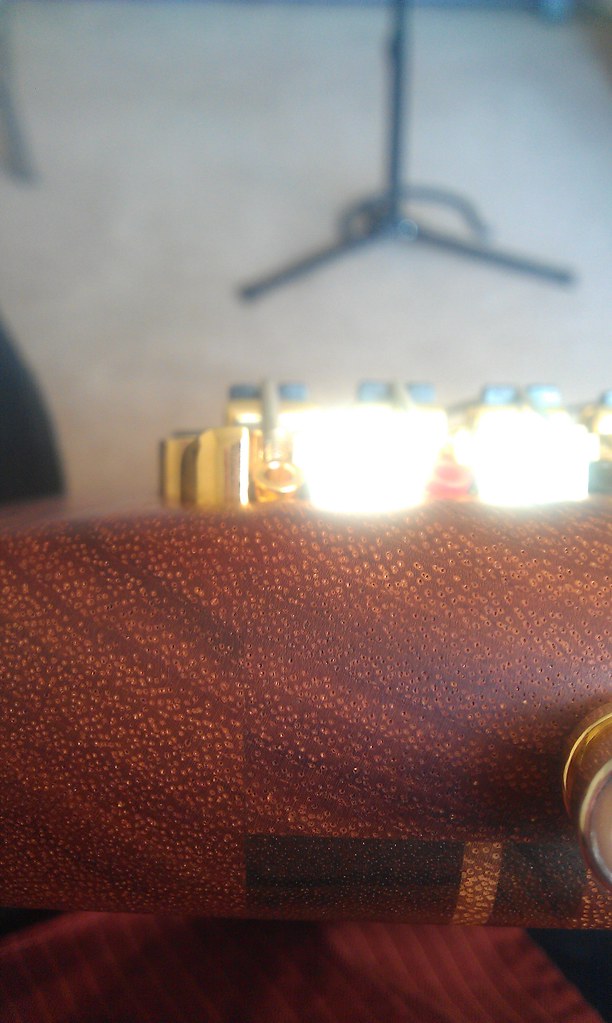
As I'm sure most of you are fully aware, the Streamer Stage II and Thumb NT uses a hidden neck through design. I think it looks absolutely amazing. I had limited experience, only playing a couple Stage II and Thumb NT's in stores previously, but finally picked up my own Stage II recently. When looking very closely, I noticed the construction was a bit different than I had presumed. I always thought they essentially built the whole body as one piece, then routed out the back where the neck would go and just glue the two together. Upon closer inspection, however, it looks more like a traditional neckthrough bass with two wings attached, and a cap over the top of the neck for the body. The grain matches very closely, and I have to get right near the bass to notice (and really the only way I noticed originally was looking at the side of the bass where the neck and body joins by the bridge strap pin, where you can see the joints pretty clearly).

However, looking through a lot of pictures (especially of Thumbs), some basses look like they may actually use one full piece. Especially the Thumb NT Pommelle, which has a very heavy grain. I guess what I'm wondering is, were these basses originally built as one piece bodies but switched to basically three pieces (or at least one piece cut into three parts) at a later date? Mine's a 2008 by the way. Or is it certain models, like a standard Stage II or Thumb NT that uses the three pieces, but special models with specific bodies/grains use a one piece design? Or is the grain just matched that well even on those models that they're nearly indistinguishable?

It obviously doesn't make a difference in the end, as I'm absolutely enamored by this bass! It looks, feels, and sounds better than I could have ever hoped! I just get curious, especially in regards to Warwicks, and its these little details that intrigue me the most.
 
Could you post some pictures of your SSII, so we can see your bass?
 
Here you can see the line where the wing and the top over the neck meet
5772730247_cc7e261189_b.jpg


And here you can see the top of the body where the wings and top meet (runs parallel with the string)
5773271468_da372c1274_b.jpg


And yet when viewed as a whole, you simply cannot tell! Talk about great quality and craftsmanship!
5773252940_4a7aa7c2cc_b.jpg
 
That is a spectacularly well matched example. My Stage 2 ('94) and Thumb ('08) are both 3-piece. You probably couldn't tell from far away (in the audience, for example), but if you have the bass in your hands then it's not hard to see the joins.

I'd be very surprised if there were any 1-piece hidden neck-through basses, but Warwickhunt would be the person to ask - he's seen enough '80s Streamers to know if there were any.
 
Just because its three pieces doesn't mean they are from different bits of wood. The afzelia on my dolphin SN is very well matched, it looks like its all one block that was book-leafed and halved.
 
doubt anyone would notice unless it was pointed out..my 99 thumb nt is very well matched also,the finish is top notch and while i know its there i have to really look to see any joints.keep using the wax/cleaner and it will stay as good as new.(i think myself all warwicks get better looking as they age)
 
I haven't read all the posts short on time , but i'll just pass this in fo on to you all .
I had a good investigation of my ,soon to be DMarco's dolphin 1990 pro I .

took pickup out .
scraped a little shielding away in bottom of route for pickup .
timber underneath is NOT the wenge of neck through laminates as i expected , its the Boire of body .
Scraped bottom of spring cavity ( even deeper hole/route ) still Boire i think i can double check this at some point .
Took body depth measurements .
Measured depth of route .
Only 10 12 mm of neck laminations left on back of body .

Conclusion =
The neck laminates pretty much end before the pick up route .

A 10 mm 'veneer' continues along the back and then is left thicker again at end for 'aesthetic' reasons i'd say .

Why ? might be to accommodate different rates of wood movement in the various woods to avoiding cracks , i really don't know
just guessing .
Might be tone .
Might be both and others have'nt had time to think about it yet .

My point is , is that the neck through laminate along the back is largely cosmetic , ie it won't have much effect on tone . Of course if it had stayed the same full depth right along it would have had more effect.
Now i've done this properly so you'll have to trust me . Some people might not like the idea of it , i'd guess knowing this would be the case HP Wilfer carried the neck through for virtually cosmetic reasons .
so all things in the bass being equal , the newer NT's that seem to stop under the neck pickup are probably no different tone wise to those made in the beginning .
If you all knew already well .... i didn't so ...
I'm rushing a bit hope what i've written understandable
 
The centre masking strip isnt routed thru to the neck. The mask is the same thickness along it's entire length.
 
I thought it would. Sorry bout that. I'm posting from mu iPhone.
The neck runs the entire length of the bass. The masking strip runs from the end of the neck, to the end pin, at a constant thickness.
The reason you don't see the neck laminates under the pickups is coz they're not routed that deep, rather than the masking strip being different thickness' or the neck finishing before the end pin.
( end pin is the rear strap button, or, the end of the body).
I hope that's easier to understand what I was saying.
 
& I think you're spot on about the hidden neck thru design being cosmetically superior than traditional NT designs. I've thought long & hard about the acoustic differences, with the pickups sitting in the top, rather than the neck itself, & I don't believe it makes any audible difference.
 
Even my pnut has a 3 piece top but with the Burl they did a great job of masking it. It looks like a one piece until you know what you're looking at
 
The german website states it to be a 2 piece design body. so the top layer in the middle is part 2 and the rest all one piece I guess :)
 
Some of my earlier post sarting and ending :-
I haven't read all the posts short on time , but i'll just pass this info on to you all .
I had a good investigation of my ,soon to be DMarco's dolphin 1991 pro I .

I'm rushing a bit hope what i've written understandable
was measured , considered and written in haste and is most definately partly Bollox ; A few corrections (IN CAPITALS) and a little humble pie eating are in order :-

NO MORE THAN 16mm of neck laminations left on back of body . NOT 10 - 12mm .

INMHO the neck through laminate along the back is POSSIBLY cosmetic , ie it MIGHT NOT have A DRASTIC effect on tone .

"so all things in the bass being equal , the newer NT's that seem to stop under the neck pickup are probably no different tone wise to those made in the beginning . " NOW THIS IS AN EMBARASSING BIT , BY "NEWER NT'S" I WAS REFERRING TO THE GLUED NECKS THAT APPEAR TO STOP PART WAY INTO THE BODY .
"A 10 mm 'veneer' continues along the back and then is left thicker again at end for 'aesthetic' reasons i'd say ." BOLLOX , i DIDN'T HAVE THE TIME TO MEASURE PROPERLY AND DOLPHINS ARE AWKWARD , ITS THE SAME ALL ALONG 16MM;
SO I'M CONCLUDING THAT (COMPARING TWO BASSES BUILT WITH THE SAME WOODS) THE 16MM NECK LAMINATES ALL THE WAY ALONG THE BACK ON MY '91 DOLPHIN MIGHT NOT MAKE THAT MUCH DIFFERENCE TO TONE WHEN COMPARED TO THE NECKS THAT STOP PART WAY BUILT WITH THE SAME WOOD .
The pickup and spring route are = 32mm deep and still showing Boire .
i HOPE THIS HAS BEEN USEFUL OR INTERESTING FOR SOMEONE COS ITS TIRED ME OUT ? WISH I'D KEPT MY MOUTH SHUT
 
Back
Top