
"$$" PU posture

golem

Philosopher King
Joined
Mar 10, 2008
Messages
3,529
Reaction score
280


Not only do I dig double humbugger tone,
but I have some "non-stock" PU height and
angle adjustment on various basses. I don't
take the one-solution-for-all approach, cuz
the available controls on some basses will
dictate certain variations.

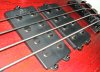
Some principles hold constant. I tend to
use a "twisted" angle between the PUs to
allow me to emphasise the bridge PU tone
of the bass side and the neck PU tone on
the treble side.

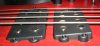
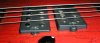
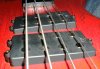
In the attached pix, the rear coil of each PU
is raised waaaay beyond just matching the
angle of the strings. This is to emphasise
the coil closer to the bridge, even if the PU
is playing its humbugger voice rather than
its single-coil voice. In one pic, you can see
fingers holding the strings down at the 24th
note, the steepest angle the strings will ever
take, and you can see that the PU tilt is way
beyond that angle.

No springs were cut or stretched, no shims
were added. This is all within the ability of
the stock adjustability of the $$ PUs.​
 

Attachments

  • Axial_Tilt_E-side.jpg
    Axial_Tilt_E-side.jpg
    133.4 KB · Views: 207
  • Axial_Tilt_G-side.jpg
    Axial_Tilt_G-side.jpg
    161.3 KB · Views: 193
  • E3_closed.jpg
    E3_closed.jpg
    91.3 KB · Views: 178
  • Latrl_Tilt_at-Nck2.jpg
    Latrl_Tilt_at-Nck2.jpg
    232.6 KB · Views: 189
  • Latrl_Tilt_at-Brg.jpg
    Latrl_Tilt_at-Brg.jpg
    224.7 KB · Views: 164
Last edited by a moderator:


Coupla caveats about using the result:

You somewhat need to relearn the controls,
cuz some controls will do MORE than they
formerly did, and some will do less.

Switching the bridge bugger to SC doesn't
really affect too much, cuz its raised rear
coil is already emphasised. Mostly it's the
tonal effect of switching its lowered coil in
or out of the impedence/capacitance mix.
Any change of PU "location" going to SC is
minimized by the PU tilt. The lowered front
coil IS audible, but never equals the rear.

The neck bugger in SC mode is not worth
much. It's the front coil that is 'live' in the
SC mode, and it is lowered so much that,
especially on the bass side, it's close to
muted. OTOH, its rear coil can be played
for cool series and parallel tonal qualities
[via the ser/par mode switch], even tho it
tends to "hear" the strings from a SC-like
location [at its own rear coil] despite really
being in a series or parallel wiring mode.

The main value of the neck PU in SC mode
is in serving an element to blend into a PU
mix thaz dialed to hugely favor the bridge
PU, like so:

In SC, the neck PU plays mainly its treble
side. So, you are blending in some neck
voiced
treble-side strings. Considering that
the bridge PU has a bass-favoring tilt, it's
a very useful trim adjustment for the new
voice of the bridge PU.

Etc etc etc, yadayada yadayadadoo. Thaz
just SOME of the new situation, the effect
on the controls. The OTHER main deal is
that neither PU is really worth playing by
itself. The PU array is now one huge manic
humbugger, with many pleasant sooprizes
within. Considering how close together the
dual buggers are, it's no loss to never 'solo'
either one. And really, you CAN "solo" the
bridge bugger if you just mix in a bit of the
neck PU in its SC switch mode [described
in previous paragraph].

So thaz it:
A. Controls somewhat "repurposed".
B. New huge manic 4-coil humbugger.
C. No actual modding.
D. Works great on a red FL. YMMV.


Last edited by a moderator:
After reading the description it all sounds kinda cool.

Somehow though it feels like a passive setup with tone controls for each pup would really help this whole thing, as your more using the blend control to add various changes making the eq redundant. - is this the case or does the pre-amp still play a part?


The EQ is not redundant, it is liberated.

IOW, the active EQ is still available, so
since I've already done its basic job with
the knobs at [or close to] center detent,
I can now ask of the EQ that which was
formerly above and beyond its abilities.

OTOH, what you suspect is true enuf so
that in passive mode I'm getting more
variation of voicing than you'd get with
the 'factory spec' PU installation.

I appreciate your thought about having
a seperate passive tone control for each
PU. I certainly wish that were a more
common feature. You will find it on a
very few "335-ish" thinlines, and some
piezo-magnetic hybrid basses do have
seperate tone control for the piezo and
the magnetic circuits, but mostly not.
I'm all for it myself !

~~~~~~~~~~~~~~~~~~~~~~~~~

Obviously, I cannot increase the actual
RANGE of the EQ ... but I can apply that
range to this beast and get more result
than if the PUs were set to stock spec's.

Sometimes you use EQ mainly to fit your
ax and rig to a new room or context, but
you don't expect the EQ to alter the very
nature of your ax, altho to some degree
EQ can do that, too. To whatever degree
you indulge in the latter, an unusual or
extreme PU set-up WILL augment the
abilities of your EQ .... not its range but
its ability to alter the nature of your ax.

 
Last edited by a moderator:
Good stuff. Thanks, golem.

I do the slanted to follow the height of the strings, with the coil closest to the bridge extra high - but I may have to try your low to high string slanting as well!


My whole left-right [lo-hi strings] PU slant
thing grows out of the difference between
reversed P-PUs and Fender-type P-PUs. I
definitely prefer the reverse-P. I prefer to
hear my twangier strings played closer to
the neck and my boomier strings played
closer to the bridge, for a sorta naturally
compensated balancing act. I'm all into
fingerstyling. I suspect a pinky-popping,
thumb-whacking slapper might just want
everything the opposite of my set-ups, to
get more extreme contrast between high
and low strings and their tones. Concept
is the same but application would be with
totally opposite intent. To each their own.


Last edited by a moderator:
Thanks a lot Golem. I actually have a Streamer $$ and I will play with these settings :-)
 
A week ago, I bought it, to test the $$ in real live situations. Nice bass so far :-) Very usable if you need to be a good foundation in a mix.
 
So i had some time on my hands and had a little play. Anyway i'm converted.

Everything sounded tighter, bouncier and more vibrant with both pups on full. Full on neck pup has wicked harmonics really sing out loud. The whole bass imo came to life.

Im gonna keep it setup like this really digging what can be achieved with it and still learning so many more things the bass is now capable of.

Highly recommended! Thanks golem for the insight!


@Callum.

Good to hear. I feel much closer to
sane knowing it works for someone
beside myself, as I have admittedly
odd taste. Thus that earlier caveat:
" Works great on a red FL. YMMV. "


Golem - i agree with Callum. this PU "posture" seems to tame the beast a bit, and it's much better for me now. thanks again for doing the photo shoot and all that...I really appreciate it!:d:d:d
 
I'll toss my hat in as a supporter of this setup. My only complaint about the $$ has been it's tendency to get "boomy". Setting the pups up this way definitely gives the bass more definition, less boom, and brings back some of that Warwick growl.

Right now I have everything in the detents. I haven't tried messing with the EQ yet to see how it works now.
 
In my messing i found boosting the bass gave back the boom. And the treble added a super zingy tone on the d and g strings that allowed for a decent slapping/popping tone on my FL $$.

@ golem, if it were for your insanity i'm sure this whole thing would never have come to light. I guess its just a gift you got :P
 
I got to try out the adjusted $$ PU posture in a band context earlier this week and I'm lovin' it & so did my band mates!
 
Back
Top