
Time for a string change has come and as usual I'm scratching my head about my Thumb setup. Let me preface that I received it brand new from a shop about three months ago and I've been good since... fact is I'm a tweaker, always (over)thinking about how to make my bass in the best shape I can.
Before performing a setup I took note of various measurements and here are some starting point:
1) The trussrod is in perfect position: neck has just a tiny relief, 0.30 mm at 7 fret with capo at first fret and E string depressed at 24th. I know Warwick Setup guide talk about 0.60 but 0.30 is a good number for me (tested on the setup I performed on the +50 instrument I've owned in my playing life, which list include almost every bass brand known to mankind).
2) Strings action is 2.25, 2.00, 1.75 and 1.5 respectively on E, A, D, G string 12th fret. Measurements stay almost constant up to the 24th. No fret buzz anywhere.
The bass came this way. And it stayed this way for three months (kudos to wood stability). I decided not to mess around with it until the first strings change, even if from day one I noticed the string height decreasing from E string to G string, which I'm not a fan at all. I know a lot of players and manufacturers as well recommend doing this but to me this whole thing throw away the purpose of matching the arc of the strings with the fretboard radius and make for an uneven feeling of the strings especially under the plucking hand (for the fret hand it's very minimal because we are talking fractions go millimeters before the string makes contact with the fret but moving through the strings with the plucking hand it's very noticeable... playing with a pic even more).
On a closer inspection I noticed that this kind of setup (performed at the shop, not at Warwick factory) was achieved by a strange interaction between the adjustability of the Just-A-Nut and the bridge. First thing I saw is that the nut height on the G string side is at the recommended height of 0.30 at 1st fret (depression string at 3rd) but on the E string side is way less... about 0.10! Nonetheless no buzz at all....
This uneveness of the nut height is kinda of counterbalanced at the bridge... the E string side of the bridge is way higher from the body than the G side. So we have kind of lower nut/higher bridge on the E side and higher nut/lower bridge on G side. My first thought would be to even each one...
I know... a lot of you would say no buzz and decent strings action is all that counts but, as I said, I'm picky and always in search for the best, smooth, effortless playing experience and I feel there's something that could be done better on this instrument setup. Maybe the guy that performed this setup first set the arc of the strings with bridge saddles, then (to achieve that "desired" height drop on the treble side) lowered the whole bridge on the treble side and finally (to maintain an even strings height) compensate lowering the nut on the E string side??? I dunno... Nonetheless before I dig into it I'm curious of what do you guys think...
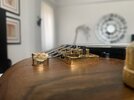
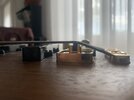
Pictures are nut treble side and nut bass side, ....

Before performing a setup I took note of various measurements and here are some starting point:
1) The trussrod is in perfect position: neck has just a tiny relief, 0.30 mm at 7 fret with capo at first fret and E string depressed at 24th. I know Warwick Setup guide talk about 0.60 but 0.30 is a good number for me (tested on the setup I performed on the +50 instrument I've owned in my playing life, which list include almost every bass brand known to mankind).
2) Strings action is 2.25, 2.00, 1.75 and 1.5 respectively on E, A, D, G string 12th fret. Measurements stay almost constant up to the 24th. No fret buzz anywhere.
The bass came this way. And it stayed this way for three months (kudos to wood stability). I decided not to mess around with it until the first strings change, even if from day one I noticed the string height decreasing from E string to G string, which I'm not a fan at all. I know a lot of players and manufacturers as well recommend doing this but to me this whole thing throw away the purpose of matching the arc of the strings with the fretboard radius and make for an uneven feeling of the strings especially under the plucking hand (for the fret hand it's very minimal because we are talking fractions go millimeters before the string makes contact with the fret but moving through the strings with the plucking hand it's very noticeable... playing with a pic even more).
On a closer inspection I noticed that this kind of setup (performed at the shop, not at Warwick factory) was achieved by a strange interaction between the adjustability of the Just-A-Nut and the bridge. First thing I saw is that the nut height on the G string side is at the recommended height of 0.30 at 1st fret (depression string at 3rd) but on the E string side is way less... about 0.10! Nonetheless no buzz at all....
This uneveness of the nut height is kinda of counterbalanced at the bridge... the E string side of the bridge is way higher from the body than the G side. So we have kind of lower nut/higher bridge on the E side and higher nut/lower bridge on G side. My first thought would be to even each one...
I know... a lot of you would say no buzz and decent strings action is all that counts but, as I said, I'm picky and always in search for the best, smooth, effortless playing experience and I feel there's something that could be done better on this instrument setup. Maybe the guy that performed this setup first set the arc of the strings with bridge saddles, then (to achieve that "desired" height drop on the treble side) lowered the whole bridge on the treble side and finally (to maintain an even strings height) compensate lowering the nut on the E string side??? I dunno... Nonetheless before I dig into it I'm curious of what do you guys think...
Pictures are nut treble side and nut bass side, ....